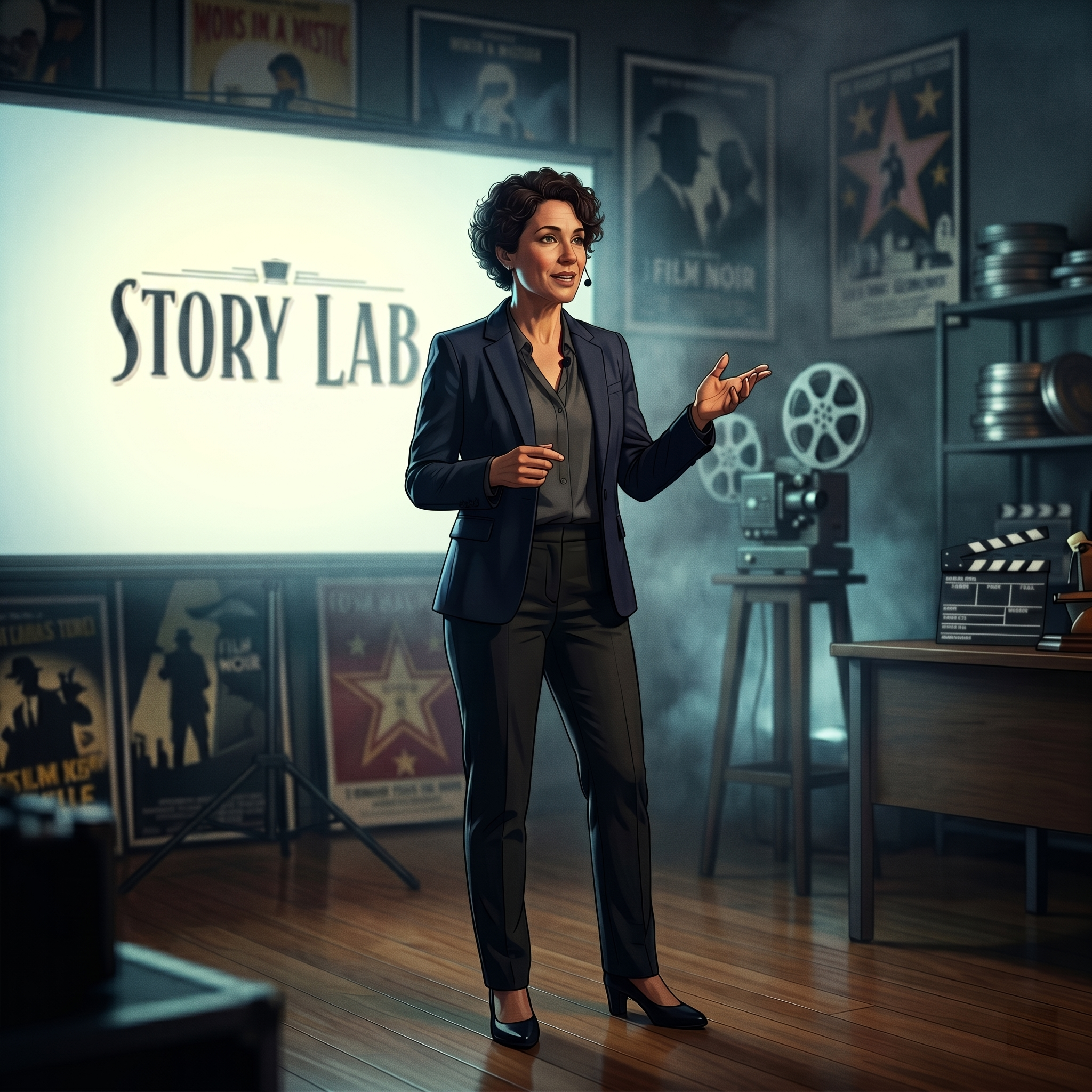
A two-hour immersive that leverages AI, science, and storytelling strategies to help leaders transform how they communicate in moments that matter.


The Story Lab helps leaders communicate in the moments that matter: pitching to an executive leadership team, presenting at a conference, briefing a minister, rolling out a major change.
It combines science, storytelling, and AI into a structured method for building communications that land.
Every part of the program integrates three dimensions: a scientific insight explaining human behaviour, a storytelling application putting that insight to work, and an AI method that extends the result.
Built during the session using a real scenario from their work.
How to reshape the same message for different stakeholders and outcomes.
Tools, workflows, and a storytelling structure that works beyond the session.
Using AI to research, draft, refine, and practise.
Each part of The Story Lab has a clear event structure and integrates three dimensions: Science, Storytelling, and AI.
| Event Structure | ScienceA theory explaining human behaviour | StorytellingHow we take advantage of this in our story | AIAn extension / multiplier that utilises AI |
|---|---|---|---|
| Pre-ProductionResearch & Ideation · ~25 min | Storyteller ProfileIndividual communication tendencies and natural strengths. How personal style shapes how stories land with an audience. | Audience UnderstandingStakeholder toolkit. What the audience values: efficiency, innovation, certainty, legacy. Shaping the message around the listener. | Researcher & Copilot ChatAI for research and ideation. Generate three strong ideas for the story, then shortlist to one to carry forward. |
| The Writers' RoomContent Development · ~50 min | Emotional Engagement & Decision-MakingWhy tension drives attention. How resolution creates action. The cognitive architecture behind the classic three-act structure. | Three-Act StructureSituation (set the scene) → Tension (raise the stakes) → Resolution (land the message). Layer in emotional engagement. Edit for clarity. | Create Agent & Copilot in PowerPointAI as creator and critic. Generate content, test against the audience profile, and iterate. Paired work means seeing different approaches in real time. |
| The AuditionPractise, Coach & Share · ~45 min | Science-based feedbackThe adrenaline response: "nervous" and "excited" are the same signal. Reframing anxiety as activation. Psychologist feedback on clarity, cognitive load, emotional resonance. | Storyteller-based feedbackPractise the most exaggerated version first. Find natural, conversational delivery. Actors model this. Storyteller feedback on craft, structure, delivery. | AI Powered FeedbackPowerPoint Rehearse with AI. Automated feedback on pace, pitch, filler words, and body language. |
Two things are completed before participants arrive.
A diagnostic surfacing natural communication tendencies and the types of professional communication participants do most. Results feed directly into session design.
Curated link sent in advance. 5 to 8 minutes. Personal and private.
Select from 7 categories (+ other) to capture most common presentation types. Shapes session content.
Participants choose from predefined scenarios that require them to draw on real work. Each frames a high-stakes face-to-face communication.
The ELT Pitch. Pitch to Executive Leadership for increased funding, resources, or a new initiative.
The Quarterly Update. Present a new system, process, or achievement at a Business Unit meeting.
The Conference Stage. Represent the organisation at an industry conference on a major project.
The Change Brief. Communicate a significant change to a team or stakeholder group.
The Stakeholder Conversation. A high-stakes conversation with a senior stakeholder.
Participants explore their storyteller profile, complete some initial ideation and explore the interests of their audience. They will use AI to practise how it can be used for ideation. The session opens with a profile-based networking activity to form working groups.
The first activity. Participants receive their completed storyteller profile and use it to find others in the room. They seek out people whose profiles deviate from their own and form working pairs or groups. This creates diversity in the groups and serves as a 10-minute icebreaker built on genuine self-discovery and sharing. This then sets the working group structure for the rest of the two hours so individuals are partnered with divergent storytellers for new insights.
Participants dive into their storyteller profile: their natural communication tendencies, strengths, and blind spots. The science of how individual style shapes the stories people tell and how audiences receive them.
An interactive stakeholder toolkit surfaces what the audience values: efficiency, innovation, simplicity, certainty, legacy. Grounded in psychological research, it helps participants understand how their story needs to resonate with the people in the room.
Using AI to explore audience motivation and generate initial approaches to the message. Participants use Copilot to come up with three strong ideas for their story, then shortlist to one to carry into the Writers' Room.
The core of the session. Participants build their message using the three-act storytelling structure (Situation, Tension, Resolution), layering in tactics for emotional engagement. They work in pairs, both using AI, learning from each other as they create.
Participants are given a practical toolkit of ingredients across the Science and Storytelling domains. A menu of elements they can bring to their story: emotional engagement tactics, structural patterns, audience psychology principles, narrative devices. They select the ingredients that fit their scenario, then use AI to build, test, and iterate as they go.
Why tension drives attention. How resolution creates satisfaction and action. The cognitive architecture behind the three-act structure participants are now applying to their own material.
Construct the message: Situation (set the scene), Tension (raise the stakes), Resolution (land the message). Layer in emotional engagement. Edit for clarity.
AI as both creator and critic. Generate content, test it against the audience profile, iterate back and forth. Paired work means participants see different approaches to the same problem in real time.
Participants shift from building to sharing. A brief introduction covers the science of performance and storytelling tips for delivery. Then participants choose their feedback panel and practise in small groups of approximately ten, with time to rotate for a second opinion.
A brief session covering the science of performance: the adrenaline response, why "nervous" and "excited" are the same chemical signal, and how reframing anxiety as activation shifts the way we communicate. Combined with storytelling tips: practising the most exaggerated version first to identify unhelpful habits, then finding natural, conversational delivery. The actors model this before participants try it themselves.
Participants share their communication and choose one feedback panel. Three options run simultaneously in groups of approximately ten. If time allows, participants rotate to get a second opinion from a different panel. A feedback capture tool is provided for each session: a structured checklist participants use to record the feedback they receive. This becomes part of their personal toolkit for self-directed practice after the session.
Feedback on the science of communication: clarity, cognitive load, emotional resonance, and what landed.
The creative consultant responds to craft: structure, delivery, contrast, and what made the story stick.
PowerPoint Rehearse with Coach: automated feedback on pace, pitch, filler words, and body language.
A combination of organisational psychologist and professional actor . The psychologist brings the science of effective communication. The storyteller brings the craft of narrative and delivery. Both are introduced at the start of the session and operate openly throughout, available as feedback panels during The Audition.
Sets the tone at the start: the contrast between a clear, well-structured message delivered conversationally and the same content undermined by over-rehearsed, stiff delivery. Communicators connect. Performers risk losing the room.
Available during The Audition. Feedback grounded in communication science: clarity, cognitive load, emotional resonance, and what landed with the audience.
Available during The Audition. The creative consultant responds to the craft: structure, delivery, contrast, and what made the story stick.
Practical, portable, and confidence-building. Each takeaway maps to a tool introduced during the session.
Built during the Writers' Room using the three-act structure and AI co-creation.
The diagnostic completed pre-session, explored during Pre-Production. Communication style and tendencies.
The full ingredient menu from the Writers' Room: emotional engagement tactics, structural patterns, narrative devices.
Copilot prompts for ideation, the custom AI agent, and PowerPoint Rehearse with Coach for ongoing practice.
The audience analysis framework from Pre-Production. Reusable for any future communication scenario.
The structured checklist from The Audition. Use it to self-assess or to capture feedback from others in future practice.
Situation, Tension, Resolution. The repeatable storytelling structure that works for any context.
Techniques from The Audition: managing nerves, the adrenaline reframe, and how communicators prepare for moments that matter.
Having practised, received expert feedback, and refined. Knowing how to rehearse and improve independently.
A permanent reference capturing everything from the experience: the storyteller profile, the full science and storytelling ingredient menu, AI prompts and workflows, the three-act storytelling framework, the feedback capture tool, and performance life hacks.
Version history